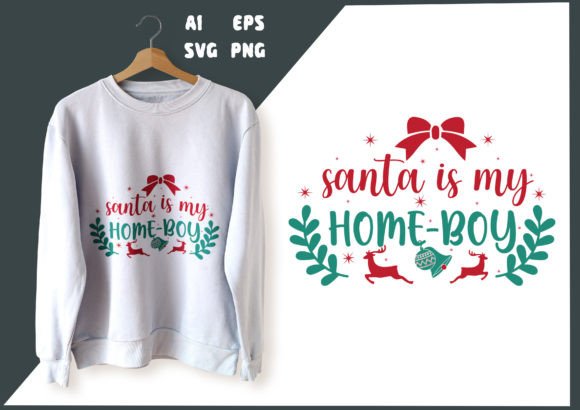
Santa is My Christmas Tshirt Design File
As someone who’s stitched holiday designs on everything from newborn onesies to boutique aprons—and shipped thousands of embroidered gifts for Etsy sellers and local craft fairs—I opened Santa is My Christmas Tshirt Design File expecting charm, but hoping for craft-ready practicality. What I found wasn’t just festive—it was flexible, focused, and quietly thoughtful in its construction.
A First Stitch That Feels Like a Conversation
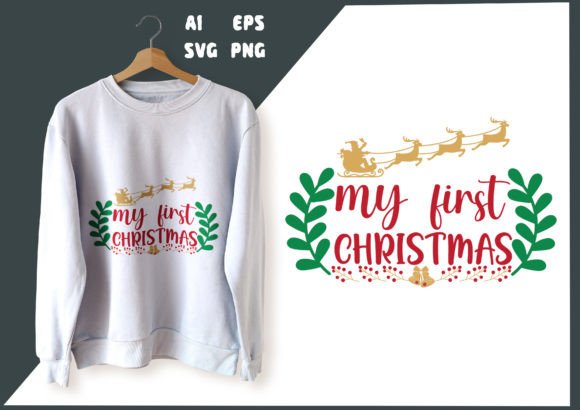
The design lands with cheerful confidence: bold Santa silhouette, friendly font, and that warm, slightly cheeky tone (“Santa is My Christmas”) that reads like a wink between friends. It’s not overly detailed—no tiny mittens or snowflakes crowding the composition—so it avoids visual clutter at smaller scales. The layout is balanced but not rigid: Santa sits comfortably left-of-center, with text wrapping naturally to his right. That asymmetry gives breathing room for embroidery placement on curved surfaces (like a sweatshirt chest or tote bag gusset) without awkward cropping.
I immediately pictured it stitched on a heavyweight organic cotton tote for a local bakery’s holiday pop-up—clean, legible, and unmistakably handmade. Not “cute” in a cloying way, but warm, confident, and human-scaled. That matters when your customer is choosing between mass-printed tees and something they’ll proudly carry through December markets.
Where It Shines—and Where It Asks for Attention
Santa is My Christmas Tshirt Design File works beautifully across several real-world embroidery projects:
- Custom apparel: On midweight cotton tees and fleece-lined sweatshirts, the lettering holds crispness without over-stitching; Santa’s outline reads cleanly even at 3.5"–4" tall.
- Tote bag design: The horizontal orientation and open negative space mean it anchors well on wide, flat fabric without pulling or puckering.
- Baby embroidery: At reduced scale (2.75"), it stays legible on onesie fronts—no fine interior details that vanish under dense fill stitch or get lost in knit texture.
- Embroidered patch: Clean outer edges and moderate stitch density make it ideal for iron-on or sew-on patches—no jagged transitions or thread-trap corners.
- Holiday gift items: Works equally well on tea towels, pillow covers, and kitchen aprons where clarity and charm matter more than photorealism.
That said—this isn’t a “set-and-forget” file. A few situations call for deliberate choices:
- Thin or stretchy fabric: Use cutaway stabilizer beneath, especially under the Santa graphic. The design’s solid areas benefit from firm backing to prevent distortion.
- Dark fabric: Test thread colors carefully. The original PNG preview suggests high-contrast white or cream stitching—but on charcoal or navy, a soft gold or brick-red thread lifts the warmth without sacrificing readability.
- Caps and curved surfaces: Avoid placing the full design across the front crown. Instead, center Santa alone (cropping the text) or shift the entire layout lower on the panel where the curve is gentler.
- Frequent-wash items (like baby clothes or kitchen towels): Confirm stitch density in the fill areas. Overly dense satin or fill stitch can stiffen fabric; lighter running stitch outlines + strategic satin accents often wear better.
What It Does for Your Craft Business—Beyond the Stitch
This isn’t just about how the design looks stitched—it’s about how it makes your finished product feel. Santa is My Christmas Tshirt Design File carries a subtle professionalism: no pixelated edges, no inconsistent line weights, no floating letters that look pasted on. That consistency builds trust—whether you’re listing on Etsy, stocking a local boutique, or gifting to a client’s family.
For Etsy sellers, it translates directly to stronger mockups: the clean SVG and PNG files drop easily into lifestyle scenes (a mug beside an embroidered towel, a child holding a personalized sweatshirt). For small shop owners, it supports cohesive branding—pair it with simple red/green thread palettes and neutral garment bases to keep inventory versatile.
And for handmade presentation? It avoids the “digital overload” trap. No excessive gradients, no micro-details that blur when stitched. Just honest, joyful shape and rhythm—the kind customers photograph and tag, not squint at.
Designer Notes You’ll Actually Use
Before stitching your first piece—or uploading to your shop—here’s what I do every time with a new embroidery file like Santa is My Christmas Tshirt Design File:
- Test on scrap fabric matching your final project’s weight and stretch.
- Check thread color contrast on both light and dark backgrounds—not just on screen.
- Review stitch density in the Santa outline and text fills; adjust if needed for delicate fabrics.
- Confirm hoop size compatibility—especially if stitching on caps or sleeves where space is tight.
- Inspect small details in the AI/EPS files: are curves smooth? Are serif ends clean? (They were—no jagged vectors.)
- Try black-and-white mockups: does the design hold impact without color? It does.
- Verify licensing before selling finished items or bundling digitally—since this is listed as Graphics under Print Templates, confirm commercial use terms directly with the seller.
Bottom line? Santa is My Christmas Tshirt Design File earns its place in a working designer’s library—not because it’s flashy, but because it’s reliable, adaptable, and quietly respectful of both machine and maker. It doesn’t shout. It smiles, settles in, and stitches true.